
The agribusiness potential of growing bamboo has expanded.
This is primarily due to advances in engineered bamboo technology in conjunction with the worldwide concern to mitigate global warming.
I wrote these in 2010.
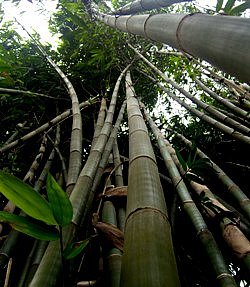
Note: Herein author wrote a school paper on bamboo in the late 1990s. It consisted of more than 30 computer-encoded pages for class reporting in graduate school. It’s a waste, that paper did not survive to this day.
Nevertheless, he published via the Web an e-book entitled “Bamboo Production and Propagation Methods” in 2010.
It also contained a statement on the feasibility of growing bamboo.
Funny, one website now assumes some kind of ownership of the book.
I myself, with my name clearly shown on the first page, could not download the file unless I register which requires giving my credit card number.
The copyright notice “Copyright @2010 cropsreview.com” is also reflected at the bottom of every page.
The brief add-ons about bamboo that immediately follows have been retrieved from memory.
“Culm” is the technical name for the bamboo pole and the main stems of other grasses.
There are many species of bamboo but the easiest to remember because of proximity to the word “bamboo” is Bambusa.
An example is the Bambusa blumeana which refers to the spiny bamboo or, in Filipino, kawayan tinik. “Kawayan” is the local name for bamboo while “tinik” is for spine or thorn.
Bamboo is a “grass”, the name given to members of the family Gramineae or Poaceae under a large grouping of plants called Angiospermae.
Angiosperms are also called “true flowering plants.”
As angiosperms, therefore, bamboos have the inherent ability to produce flowers and seeds.
There are more than 1,000 species of bamboo in the world.
These are subdivided into several types such as the erect vs. prostrate vs climbing type and the clump-forming or sympodial vs. nonclump-forming or running or monopodial type.
The clump-forming type, exemplified by the spiny bamboo, is common in the Philippines.
The nonclump-forming type is descriptive of those where individual clumps tend to separate from each other, like those in old Chinese movies with mystical swordsmen flying from culm to culm.
The multiple uses of bamboo are partly mentioned below but there’s one which is rarely known: the use of a section of culm in place of steel pot for cooking.
The author is fortunate enough to have witnessed the cooking of rice, ground cassava, bullfrog, and various native foods in bamboo.
They sure tasted good!
There’s also that article in National Geographic that panda eats bamboo.
That because the bamboos in an entire mountain simultaneously died, the pandas starved.
It’s quite unbelievable that an entire population of bamboo would die at the same time. But if you know bamboo, it’s not really hard to believe.
The flowering phenology of bamboo should be one of the most bizarre things in plants in the same way that upon reaching maturity sea-dwelling turtles go back to the place of their birth to lay eggs.
It may take 20 years, or 60 years, for a bamboo species to produce flowers, but once it happens, all bamboo that originates from one single clump will flower at the same time!
Provided they are mature and the environmental conditions are favorable.
And considering that bamboo is grass, it is not surprising if it will die soon after the seeds ripen.
This determinate habit happens also in grass crops like rice and corn.
Growing Bamboo Can Be Rewarding
I wrote this section in 2010 believing that indeed, there’s promise in growing bamboo.
The bamboo plant is no longer a poor man’s timber.
Traditionally used for household convenience including the source of low-cost materials for house construction, tools, vegetable, and ornamentation, it has now established its commercial value as a timber substitute and for multiple numbers of uses as an engineered product.
Engineered bamboo or e-bamboo is the mechanical and chemical manipulation of the bamboo pole to produce products that serve as a substitute for wood.
The engineered products include planks, tiles, balusters, mats, veneer, plywood, and boards.
Finished products using 100 percent engineered bamboo include doors, windows, flooring, trusses, beams, chairs, desks, tables, and furniture.
In Mexico City, architect Simon Velez built the 55,200-square-foot Nomadic Museum using bamboo which is also referred to as “vegetal steel”.
The building occupied half of the Zocalo, Latin America’s largest plaza.
He built more structures around the world. (Associated Press, 2008).
The press release also says that there are a few commercial bamboo farms to meet the growing demand.
According to Van Der Lugt and Lobovikov (2008), the current value of the international bamboo trade is probably between US$1.5 to $3 billion with China as the main supplier, followed by India.
The European Union (EU) and the USA are the largest importers, accounting for up to 80% of the total bamboo imports.
They noted that besides flooring, markets for other engineered bamboo products such as veneer, panels, and boards are growing.
The stable worldwide demand for wood and the increasing interest in sustainably produced timber further boost the potential market for industrial bamboo products.
Among many western consumers, bamboo is an inherently sustainable resource.
Thus industrial bamboo is seen to compete for hardwood in the twenty-first century.
However, the present supply from natural stands is limited.
This needs to be increased manyfold by growing bamboo on available land.
According to Einav (2009), UNIDO has helped India “rediscover” bamboo. India’s current demand for bamboo is an estimated 27 million tons.
But only 50 percent of that demand can be met because of a lack of facilities for value addition and transportation.
Worldwide trends on supply and demand, therefore, clearly strengthen the feasibility of growing bamboo in a commercial scale.
On May 14, 2010, Executive Order No. 879 was issued by the president of the Philippines.
It created the Philippine Bamboo Industry Development Council and directed the use of bamboo for at least 25 percent of the desk and other furniture requirements of public elementary and secondary schools.
It also directed the prioritization of the use of bamboo in furniture, fixtures, and other construction requirements of government facilities.
Moreover, said Order rationalized, among others, that “the Philippines has committed to reforesting at least 500,000 hectares with bamboo as part of the 1 million hectares of designated areas as its contribution to the ASEAN commitment of 20 million hectares of a new forest by 2020 as part of its initiatives to improve the environment”.
This pronouncement indicates that growing bamboo is an international initiative designed to mitigate adverse climatic changes and for ecological enhancement.
The statistics also indicate the feasibility of establishing plant nurseries and growing bamboo.
The Promise of Bamboo was Broken: Author’s Update
Despite the above sales talk on the feasibility of bamboo, it appears that nothing happened.
I used to provide free consultancy services to the Department of Trade and Industry in order to promote the propagation and planting of selected species.
I conducted seminars on their mass propagation and culture.
There was then a businessman who planned to establish a manufacturing plant for engineered products.
For some reason, it did not materialize. With time the promise of bamboo as a cash crop waned. Then silence ensued.
Is it because there’s a lack of supply to feed a manufacturing plant? We can only speculate, absent factual data.
But the reality is that farmers have learned their lessons. They have become skeptical.
Too many crops have been promoted by authorities as “get rich fast” farming strategies but failed.
Some examples are gmelina, neem tree, physic nut or tuba-tuba, and moringa. All provided lessons in crop selection.
Now to answer those who may be curious. Did I join those No No’s in growing bamboo?
No, I did not stop growing bamboo. But only in a sustainable, affordable way.
I continue anyway to make use of the plant for varied purposes in the farm such as in house construction, fencing, and in constructing trellises for vegetables and farm structures including a kiln for copra-drying.
With only a few clumps in the farm, I had to harvest from adjacent farms.
I badly need plenty of that weevil-resistant bamboo with mosaic-designed skin!
References
Associated Press. 2008. Boom in bamboo buildings has green benefits. Retrieved September 3, 2010 from http://www.msnbc.msn.com/id/22934387/.
Einav, T. 2009. Bamboo: an untapped and amazing result. Retrieved September 3, 2010 from http://www.unido.org/index.php?id=1000276.
Rural Micro Enterprise Promotion Program (RuMEPP). 2010. Engineered Bamboo: The Industry, Technology & Other Information. Department of Trade and Industry, Philippines. 74 p. (booklet).
Van Der Lugt, P. and M. Lobovikov. 2008. Markets for bamboo products in the West. Retrieved September 3, 2010 from http://www.bambooteam.com/pablo/200801%20BFT%20published%20article.pdf.
(Ben G. Bareja, 2010, updated Apr. 25, 2019)
