
Several flower types occur in the angiosperms. The main classifications are briefly discussed below.
Complete vs. Incomplete Flower Types
There are four tissues all or some of which make up a flower as a structural organ in the angiosperms: sepal, petal, stamen, and pistil.
Based on whether all of these four floral parts are present or anyone is absent, flowers are classified as either complete or incomplete.
A flower is called complete if all four floral organs are present in the same flower structure.
A commonly illustrated complete flower is that of the gumamela or China rose (Hibiscus rosa-sinensis).
An incomplete flower lacks any one or more of these parts.
The flowers of grass plants (family Gramineae or Poaceae) are mainly wind-pollinated and are incomplete, lacking both sepals and petals.
Relying on the wind to accomplish pollination, there is no need for these flowers to attract pollinators.
Perfect vs. Imperfect Flower Types
Flowers that contain both sexual parts (stamen and pistil) are called perfect or bisexual or hemaphrodite or hermaphroditic while those that contain either stamen or pistil only are called imperfect or unisexual flowers, regardless of whether they have or lack either sepal or petal or both.
All complete flowers are also perfect.
The flower of rice (a member of the family Gramineae), although incomplete, is perfect.
All beans and peas have perfect flowers.
The separation of the male and female sexual organs increases the possibility of outcrossing or cross pollination.
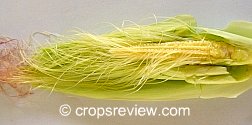
Imperfect flowers are found in corn (Zea mays), squash (Cucurbita maxima), bitter gourd (Momordica charantia), watermelon (Citrullis lunatus), and coconut (Cocos nucifera).
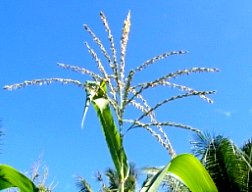
Imperfect flowers that bear pistils only are called pistillate flowers (considered female flowers) and those that bear stamens only are called staminate flowers (considered male flowers).
In corn, the miniature ear that is borne on the leaf axil but concealed by enveloping bracts is an inflorescence containing pistillate flowers, and the “silks” that protrude at the tip are elongated styles.
The corn tassel, which arises at the apical part of the plant shoot, is an inflorescence bearing spikelets that contain staminate flowers.
To sum it up, there are three distinct individual flower types: pistillate (female), staminate (male), and perfect (both pistil and stamen are present).
They are used as a basis in classifying plant species as well as the sex of individual plants.
Some Rules of Thumb and Buts
1. All complete flowers are perfect because they necessarily have both the stamen and pistil (examples: hibiscus, roses, beans, pea).
2. But not all incomplete flowers are imperfect because both the stamen and pistil may be present and what makes the flower incomplete is the absence of either sepal or pistil or both.
For example, the flower of rice is incomplete there being no sepals and petals, but it is perfect with both stamen and pistil.
3. All imperfect flowers are incomplete because either the pistil or stamen is lacking (example: the staminate and pistillate flowers of squash).
4. But not all perfect flowers are complete because even though both stamen and pistil are present, the flower is incomplete due to the absence of either or both the sepal and petal (example: rice).
Flower Types Affecting Pollination
As to synchrony in the maturation of the male (stamen) and female (pistil) flower parts, flowers are called dichogamous when the two organs mature at different times.
Dichogamy, as in the avocado, is a natural mechanism by which plants avoid self pollination within the same flower (autogamy) thus reducing inbreeding and, conversely, promoting cross pollination.
Dichogamous flowers are either protandrous or protogynous.
Protandrous flowers (n. protandry), as in carrots, are those in which the stamens mature ahead of the pistils so that by the time that the stigma becomes receptive, the pollen grains within the same floral structure are already shed.
Protogyny is the reverse of protandry. The stigma of protogynous flowers, as in the water lilies (Nymphaea spp.), becomes receptive while the pollen grains are still immature.
Flower types also differ depending on whether they open or remain close during the pollination period (click here to read Types of Pollination).
Chasmogamous flowers (n. chasmogamy) are open during the period of pollination and are generally cross-pollinated.
In the cleistogamous flowers (n. cleistogamy) of tomato, lettuce, and some rice species, the flowers do not open during the period of pollination and thus these plants are largely self pollinated.

very informative, helpful and easy to underrstand.