
Hereunder is a list of palms that have been traditionally tapped for sap. The harvested sap has been processed into palm sugar but there are other uses.
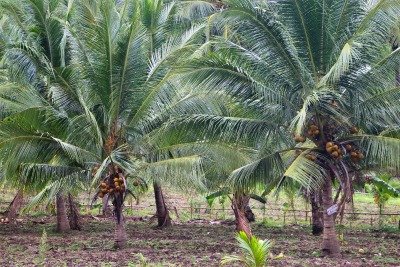
As already mentioned on a separate page, the palms are considered one of the major sources of sugar in the world.
Special mention of Phoenix sylvestris, Borassus flabellifer, Cocos nucifera, and Arenga pinnata was made by Hill (1972) and these were also reviewed by Dalibard (1997; 1999) along with other palm species.
The entries on geographical distribution were obtained from globalspecies.org (2011).
These palm trees are among more than 30 species that Dalibard (1997; 1999) reviewed as having been traditionally tapped for sap with promising prospects for use as animal feed.
The list is not exclusive.
Although most tapped palms yield sap with high sugar content, many are used to make wine, vinegar, and other products instead of sugar.
The author of this page himself has lived in close proximity to coconut palm trees that are tapped daily for sap.
He also had personal experience in the tapping of sweet palm or kaong (Arenga pinnata).
The List of Palms
Table 1. List of palms that have been utilized as sources of palm sugar in different tropical regions of the world.
| COMMON NAME | SCIENTIFIC NAME | DISTRIBUTION |
|---|---|---|
| Areca nut, Arecanut, Areca palm, Betel nut, Betel palm, Bunga | Areca catechu | Cultigen from Malesia |
| Aren Gelora | Arenga undulatifolia | Borneo, Philippines (Palawan), Sulawesi |
| Philippine Dwarf Sugar Palm | Arenga tremula | Philippines |
| Sugar palm, Arenga palm, Kaong, Gomuti, Ijuk, Areng palm, Black fiber palm | Arenga pinnata syn. A. saccharifera | Assam to Malesia; China to C. Malesia |
| Asian Palmyra palm, Sugar palm tree, Toddy palm, Desert palm | Borassus flabellifer | India to SC. China and Indo-China, Jawa to Lesser Sunda Is. |
| Buri palm, Gebang palm, buli, Cabbage palm, Bajur palm | Corypha elata / Corypha utan | Andaman Is. to N. Australia; NE. India to N. Australia |
| Fishtail palm, Philippine fishtail palm, Pugahan | Caryota cumingii | Philippines |
| Jaggery palm, Toddy palm, Solitary fishtail, Kitul palm, Wine palm | Caryota urens | Sri Lanka, Myanmar and India |
| Coconut, Coconut palm | Cocos nucifera | C. Malesia to SW. Pacific, widely introduced elsewere |
| Date palm | Phoenix dactylifera | Arabian Pen. to S. Pakistan, widely introduced elsewere |
| Dwarf date palm, Senegal date palm | Phoenix reclinata | Trop. & S. Africa, Comoros, Madagascar, SW. Arabian Pen. |
| Wild date palm, Silver date palm, Sugar date palm | Phoenix sylvestris | Indian Subcontinent to W. Myanmar; Pakistan to Himalaya, E. India to Bangladesh |
| Nipa palm, Water coconut, Attap palm, Mangrove palm | Nypa fruticans | Sri Lanka to Nansei-shoto and Caroline Is. |
| Talipot palm | Corypha umbraculifera | SW India, Sri Lanka |
REFERENCES
DALIBARD C. 1997. The potential of tapping palm trees for animal production. Retrieved December 17, 2011, from http://www.fao.org/ag/againfo/resources/documents/frg/conf96htm/dalibard.htm.
DALIBARD C. 1999. Overall view on the tradition of tapping palm trees and prospects for animal production. Livestock Research for Rural Development. Vol. 11, No. 1. Retrieved December 17, 2011, from http://www.lrrd.org/lrrd11/1/dali111.htm.
GLOBALSPECIES.ORG 2011. Accessed December 17, 2011, thru http://globalspecies.org/ntaxa/2008146.
HILL AF. 1972. Economic Botany. TMH ed. New Delhi: Tata McGraw-Hill Publishing Company. p. 210-241.

