
This how-to guide in growing durian reviews the cultural practices from plant propagation and land preparation to harvesting.
Plant Propagation
Plant propagation can be by seed, but for uniformity, smaller stature, and early maturity, it is better to use clones produced by asexual methods such as grafting and budding.
Seeds are sown immediately after extraction without the necessity of prior drying.
Overdrying will in fact tend to kill the embryo because the seed is recalcitrant.
The recommended method of budding is patch budding.
Grafting techniques used are inarching, cleft grafting, hypocotyl grafting, and epicotyl grafting.
The seedlings can be outplanted after about one year, or further extended to three years in the nursery to produce large planting materials (LPM).
LPMs have a better chance of survival and the trees mature earlier.
Land Preparation
The land is prepared for planting by first clearing and removing stumps, followed by plowing and harrowing two times.
If the soil is too acidic, it can be corrected by applying agricultural lime.
But with staggered planting, plowing and harrowing can be dispensed with and only the immediate peripheries of hills are cultivated.
Holing and Planting
Holes at least 50 cm deep and wide are dug 8-12 m apart.
Close spacing may necessitate thinning after 8-10 years to disperse the trees.
These spacings correspond to a planting density of about 70-156 plants per hectare in the square system or 80-180 in triangular planting.
After holing, the removed topsoil is mixed with compost and used to partly refill the hole.
A small amount of lime is added to the mixture if the soil is too acidic.
However, the addition of compost during planting is not absolutely necessary for plant establishment.
The seedling is carefully laid on the hole with the potting container removed.
The depth of planting should be such that the root crown is in line with the level of the land.
The more soil-compost mixture is then added and slightly pressed to eliminate air spaces.
Water is immediately applied.
But in places with irregular rainfall and which are not easily flooded, it is better to leave a slight depression around the seedling to trap water.
Planting should be done at the start of the rainy season to ensure the availability of water. The plants should be provided with shade for two weeks or until they are fully established.
Weeding and Fertilization
Regular weeding should be done to eliminate competition for water and nutrients.
Thick undergrowth under the canopy of trees will also increase relative humidity near the trunk which favors the reproduction of pathogens.
To avoid injury to the roots, the soil should not be scraped. Weeds below the canopy can be totally eliminated by hand pulling.
In addition, the formulation of a fertilizer management program is important in growing durian.
The program should ensure the vigor of trees with the sustained capacity to produce quality fruits.
Fertilizers should be applied based on soil analysis.
In the absence of soil analysis, 50 g of complete fertilizer may be applied during planting.
The rate of fertilizer is correspondingly increased with the age of the plants, to be applied during the onset of the rainy season and when it is about to end.
Otherwise, fertilization can be done periodically in 2-4 applications per year.
Ring weeding should be done before fertilization.
To ensure a steady supply of micronutrients, it is desirable to incorporate the application of organic fertilizers with the fertilization program.
Water Supply, Drainage, and Mulching
Water should be supplied daily to the newly planted seedlings until they are firmly established.
Thereafter, watering is done periodically to ensure that the plants are not subjected to water stress, especially during drought.
Water is especially needed during the flushing period and from floral induction to fruit development stages.
Prolonged drought may be fatal to the plants.
To minimize rapid drying of the soil during the dry season, mulching is practiced.
This involves the laying of rice straw, uprooted grasses, coconut husk, or any other mulching material on the ground around the durian trees.
Mulching on the under-canopy should be avoided during the rainy season.
It is also important that the durian orchard is provided with drainage canals to remove excess water during the rainy season and to reduce the incidence of Phytophthora.
Standing water can increase relative humidity which favors the growth of pathogenic organisms.
Disease inoculum can spread from tree to tree when there is surface runoff.
Pruning of Durian
Proper pruning is one of the least considered activities but should be made an integral practice in growing durian.
Formative pruning is practiced during the first years following planting.
This is done by removing excess trunks, upright branches, and watershoots, as well as thinning the horizontal branches.
Only a single trunk should be allowed to develop.
Removal of excess branches will favor maximum penetration of sunlight and promote air circulation.
The trees may also be top pruned at a height of about 5-10 m to limit the tree height.
Likewise, the removal of branches 1-2 m from the base of the trunk will help prevent the incidence of diseases as well as facilitate movement.
Diseased branches should be removed immediately and burned.
Click here to read how I apply bonsai rules in pruning.
Intercropping
In multiple cropping, durian trees are commonly grown as an intercrop under coconut.
In durian orchards, the vacant strips between rows of durian can be utilized for the growing of annual crops or fruit crops such as banana, guava, rambutan, citrus, and papaya.
These crops can provide substantial income at a time when the durian trees have not started bearing fruits yet.
Banana is commonly preferred to provide partial shade during the first two years after planting of durian.
For the purpose of shading, lakatan banana is better planted in advance and removed when the durian trees are 3 years old.
Fruit Thinning, Tying, and Propping
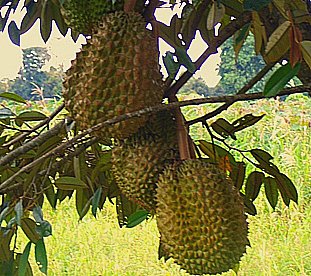
Fruit thinning or the removal of excess and deformed fruits is done 35-50 days after the fruit set.
It is practiced not only for the purpose of producing quality fruits of the right sizes and is free from insect damage, but more so for the benefit of the tree.
By retaining a number of fruits proportionate to the branch size and the number of leaves in the branch, the vigor of the tree will not be sacrificed.
Usually, a fruit weighing 2 kg needs 150-200 leaves for its full development.
To prevent the dropping of mature fruits to the ground, the fruits are secured by a plastic twine and tied to the branch.
To prevent heavily fruit-laden branches from breaking, they are supported with bamboo props or tied with a thick rope to the upper parts of the main stem or other sturdy branches.
Harvesting
Mature fruits should be harvested during sunny days. Extreme care must be exercised to prevent bruising.
The following indices are used in determining the right time to harvest:
1. Depending on the variety and elevation, the fruit has reached minimum days of development starting from flower bloom.
2. Fruit color turns yellowish-green or brown.
3. The sutures between adjoining fruit segments are distinct.
4. The tip of the spikes turns darker brown than the bases.
5. The tips of the spikes are pliant.
6. The fruit when tapped has a dull and hollow sound.
7. The fruit emits a strong aroma.
Insect Pests and Diseases Control
The most serious pest and disease of durian are fruit borer and Phytophthora, respectively. These are treated separately in Part III of this article.
The page also provides the list of references used. (Click here to read)
