
Top-grafting, or topworking, is the grafting of the top portion of a plant that is already mature or large enough to have several branches.
An equivalent technique in which budding is used is called top-budding.
The technique is not new, it has in fact been thoroughly discussed by Hartmann and Kester (1975) in their book Plant Propagation: Principles and Practices.
The authors say that the technique is used to convert an already established long-lived plant, either a tree, a shrub, or a vine, into another variety or cultivar.
Accordingly, apples and pears are examples of long-lived plants that can be top-grafted.
Reminiscing
Back in the year 1999, we were familiar with the intervarietal conversion of adult plants by top-grafting only as applied in rejuvenating old, unproductive coffee in the Philippines.
The procedure essentially involves the cutting of the tree about 30 cm (1 foot) from the ground and allowing sprouts to develop from the stump.
When the sprouts reach a graftable size, 5-7 are cleft grafted but only 3 to 5 are usually retained and allowed to develop.
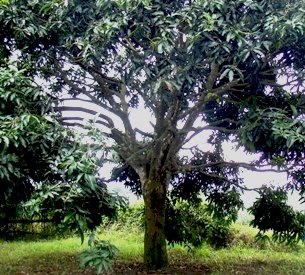
But then one day in one of our personal weekend expeditions intended to educate ourselves, we happened upon Pabon’s farm in Polo, Polomolok, South Cotabato close to the foot of Mount Matutum, with vast plantation of Dole pineapple to the west.
The farm was planted to hundreds of mango trees which, aged about 5 years old with a trunk diameter of about 10-15 cm (4-6 in), have already started producing fruits.
When the farm owner bought the grafted seedlings, he was assured by the vendor that the seedlings were those of the “Luzon” variety, supposedly one of the best of the Philippine Carabao variety.
But, to his dismay, he discovered that the fruits were entirely different from that of the Carabao variety, now also called Manila Supersweet mango or simply Philippine mango and others.
Totally convinced then of the viability of mango farming, the farm owner had no choice but to replace the mango trees by replanting new seedlings.
Luckily, he did not right away cut the trees.
He started planting grafted seedlings from a reliable source in between the existing rows.
That was when we passed by, noticed the new plantings, and became curious why he did it.
Actual Demo on Top Grafting Did It
To cut it short, we advised him that he could still proceed with his plan of going into mango farming without replanting which would mean another expenditure and waiting years for the seedlings to mature.
To convince him further, we conducted two demo studies to compare methods of rootstock preparation:
(1) cutting of the trunk above the graft union,
(2) cutting off all lowermost scaffold branches with short stubs left and of the trunk above these branches,
and (3) similar to 2 except that one branch was retained intact to serve as nurse branch.
A nurse branch is one that is deliberately left to ensure continuity in the production of food through photosynthesis for the whole plant that is devoid of other leaves.
It is intended to be removed later.
Joefran Gallego and Rogelio Gonzales did it all, including the actual top-grafting works, and recorded the results.
The demos were, at the same time, their undergraduate thesis.
In just a few days, multiple shoots emerged from the decapitated trunk and from the stubs of the branches.
At 30-40 days from a cutback, 7-8 shoots around the trunk (in rootstock preparation 1) and 2-3 shoots from each branch and upper trunk were cleft-grafted with scions collected from a nearby fully-grown carabao mango tree.
Grafting’s success was nearly perfect. In contrast, potted mango seedlings usually reach ordinary pencil size, the right size for grafting, 6-8 months from seed sowing.
This is a practical method of applying the concepts in grafting plants.
The technology involved the application of cleft grafting, topworking or top-grafting, and double grafting.
- The cleft grafting technique was used in grafting individual sprouts;
- top-grafting was applied in regrafting the tops of the trees;
- and double grafting was applied because there were two successive grafting operations, the first grafting consisting of the original grafting of the seedlings and the second being made on the part of the original scion which here became the interstock or intermediate stock.
Adoption of the Technology
Thereafter, the top-grafting technique following the preparation of the rootstock by cutting branches was applied to the other mango trees.
From time to time, we received updates that there was the rapid development of the tree canopy and that in only two years the tree sizes were already comparable to other mango trees in nearby farms that were planted at the same time.
Just recently after 12 years, we visited the farm on our way home from a neighboring farm whose owner needed technical assistance.
We were told that for years Pabon’s mango trees have been producing fruits regularly through the application of chemical floral induction technology.
We entered the farm and found that the trees were generally healthy without any sign of previous cut and top-grafting except those of the original union when the seedlings were first grafted.
The wounds completely healed and there was no indication whatsoever that the trees were topworked.
The farm is now popularly referred to in the community as the one where adult mango trees were converted to Carabao mango.
Is Top-grafting Applicable to Old and Large Mango Trees?
The answer should be yes.
We recently tried this on trees more than 20 years old mostly with a trunk diameter of about 40-50 cm at the base at the Mindanao State University, General Santos City.
These trees were intended to be removed as part of a thinning operation.
The topmost cut was made about 8 feet (2.4 m) from the ground.
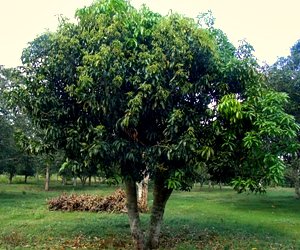
A top-worked tree reverted to juvenile growth (see above photo of double-trunked mango) and we learned many lessons including the realization that the process is labor-intensive.
We concluded that:
- any tree to be top-grafted should be healthy;
- cutting-preparation of the tree should be done when climatic conditions are favorable for growth;
- water supply should be ensured until the tree has developed a relatively large canopy;
- the flushes of growth should be timely protected from insect pests;
- new sprouts keep on emerging every few days;
- and that new, ungrafted sprouts, as well as the excess or out-of-place surviving grafts, should be removed.
LITERATURE CITED
HARTMANN HT, KESTER DE. 1975. Plant Propagation: Principles and Practices. 3rd ed. New Jersey: Prentice Hall Inc. 662 p.
(Ben G. Bareja and Efren M. Sioquim 2012, edited May 26, 2015)
