
What is a fruit? This question is always asked in association with another question “What is a vegetable?”
These questions are repeatedly asked and without doubt, will be asked over and over again.
The reason is that the word fruit has many meanings based on various criteria. It can refer to a part of a plant, a type of tree or crop, or a particular food item.
As to vegetables, there is a special classification called fruit vegetables which refers to crops in which botanical fruits are harvested primarily for use in culinary preparations, such as tomato and squash.
Indeed, based on common usage, fruits refer to the plant structure having sweet, edible portions and generally consumed raw as contrasted to vegetables which refer to edible plant parts which are generally consumed cooked but some in raw form as a salad.
To underscore the importance of clarifying what is a fruit, here are some usages or references to the term:
(1) Technically, the “kernel” of corn is a fruit called “caryopsis”. (a botanical reference to fruit as a plant organ);
(2) The mango tree is a fruit. (referring to the mango tree as a fruit crop);
(3) This banana fruit tastes good. (referring to the banana fruit as a food item that is generally consumed raw).
To add to the confusion, here is a common but contrasting statement: “I will go to the market to buy fresh tomato vegetable” (for consumption of the tomato fruit as a vegetable).
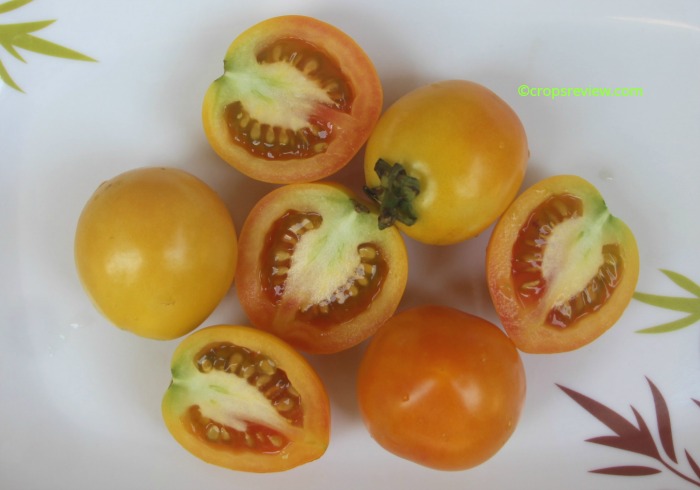
What is a Fruit: The Case of Tomato
The question “Is the tomato a fruit or a vegetable?” is not new.
The question is so valid that it became a legal issue more than a century ago.
On May 10, 1893, the Supreme Court of the United States settled the controversy on what is a fruit and what is a vegetable within the meaning of the Tariff Act of March 3, 1883, which imposed a tax on imported vegetables. In its ruling declaring that tomato is both a fruit and a vegetable, it said:
Botanically speaking, tomatoes are the fruit of a vine, just as are cucumbers, squashes, beans, and peas.
But in the common language of the people, whether sellers or consumers of provisions, all these are vegetables which are grown in kitchen gardens, and which, whether eaten cooked or raw, are, like potatoes, carrots, parsnips, turnips, beets, cauliflower, cabbage, celery, and lettuce, usually served at dinner in, with, or after the soup, fish, or meats which constitute the principal part of the repast, and not, like fruits generally, as dessert. (Nix v. Hedden, 149 U.S. 304 (1893), retrieved December 21, 2010, from http://caselaw.lp.findlaw.com/cgi-bin/getcase.pl?court=us&vol;=149&invol;=304).
Indeed, the tomato, that usually a roundish structure that is harvested from a tomato plant, is botanically a fruit, a reproductive organ that flowering plants produce.
Likewise, it is a vegetable, a term that is used for plant parts that are consumed cooked, or otherwise used in some other ways in culinary preparations.
In fact, the tomato plant has long been grown on a commercial scale as a vegetable crop, a term in horticulture that refers to plants grown for the primary purpose of harvesting them or any plant part for use as an ingredient in the preparation of vegetable dishes or any culinary preparation.
Click here to view the list of fruit vegetables
This Page Is About the Fruit as a Plant Organ
The fruit is a plant organ that is considered a reproductive part of the plant shoot system in the angiosperms, along with the flower and seed.
It is distinct from the vegetative parts of the plant shoot which consist of the stem and leaves. Its participation in plant reproduction, however, is indirect.
Its main functions are to enclose and protect the seed and to help in its dispersal.
The fruit is unique to the angiosperms or flowering plants, having developed from a flower that is found only in this group of plants.
It is responsible for the “enclosed” or “covered” seeds of the angiosperms. In contrast, gymnosperm means “naked seed.”
What is a Fruit: Fruit Parts
The fruit is a ripened (or mature) ovary or group of ovaries usually containing a seed or seeds.
It develops from a flower after double fertilization.
It may also include the receptacle, as well as other flower parts such as the sepals, petals, stamens, and portions of the style.
In some plants, seedless fruits develop without fertilization through a process known as parthenocarpy.
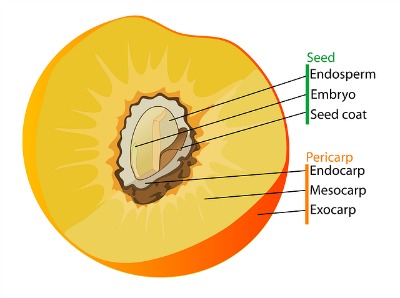
During fruit development, the ovary wall thickens to become the fruit wall or pericarp which surrounds the seed or seeds.
The pericarp (commonly called rind or peel) consists of three layers of tissues: exocarp or epicarp, mesocarp, and endocarp.
These fruit parts may be clearly separated or they may be tightly fused so that they are difficult to distinguish from each other.
In cashew (Anacardium occidentale), the fruit type is that of a kidney-shaped drupaceous nut with a resinous hard pericarp.
The “cashew apple” is a pseudofruit or false fruit consisting of an enlarged and swollen pedicel.
The exocarp is the outermost part of the pericarp and is often the visible skin of the fruit.
It consists of the epidermal and subepidermal layers of fruits, with various classifications based on texture and appearance such as glabrous (no pubescence), glaucous (waxy bloom), finely pubescent, and densely pubescent. It may also be represented by a hard, thick, or leathery rind.
The exocarp is one of the bases in the classification of fruits into various fruit types.
The mesocarp is the middle layer of the pericarp between the exocarp and endocarp.
In mango, the mesocarp is the edible, fleshy portion that is eaten between the outer peel and the seed inside.
This edible portion is the one that is, in common usage, associated with what is a fruit.
In young coconut, the mesocarp is relatively soft when young but becomes the dry and fibrous husk of the mature fruit.
The endocarp is the innermost layer of the pericarp, the part that immediately encloses the seeds.
It occurs in various forms and textures ranging from thin and papery to hard and stony as in the fruit type called a drupe.
In mango fruits, the endocarp is thick, woody, and fibrous; in coconut, it is represented by a hard shell.
Some fruits are supplied with appendages mainly for the purpose of dispersal.
The fruits may be supplied with winged appendages, tufts of hairs, hooked or barbed bristles, spines, or some glandular projections.
